

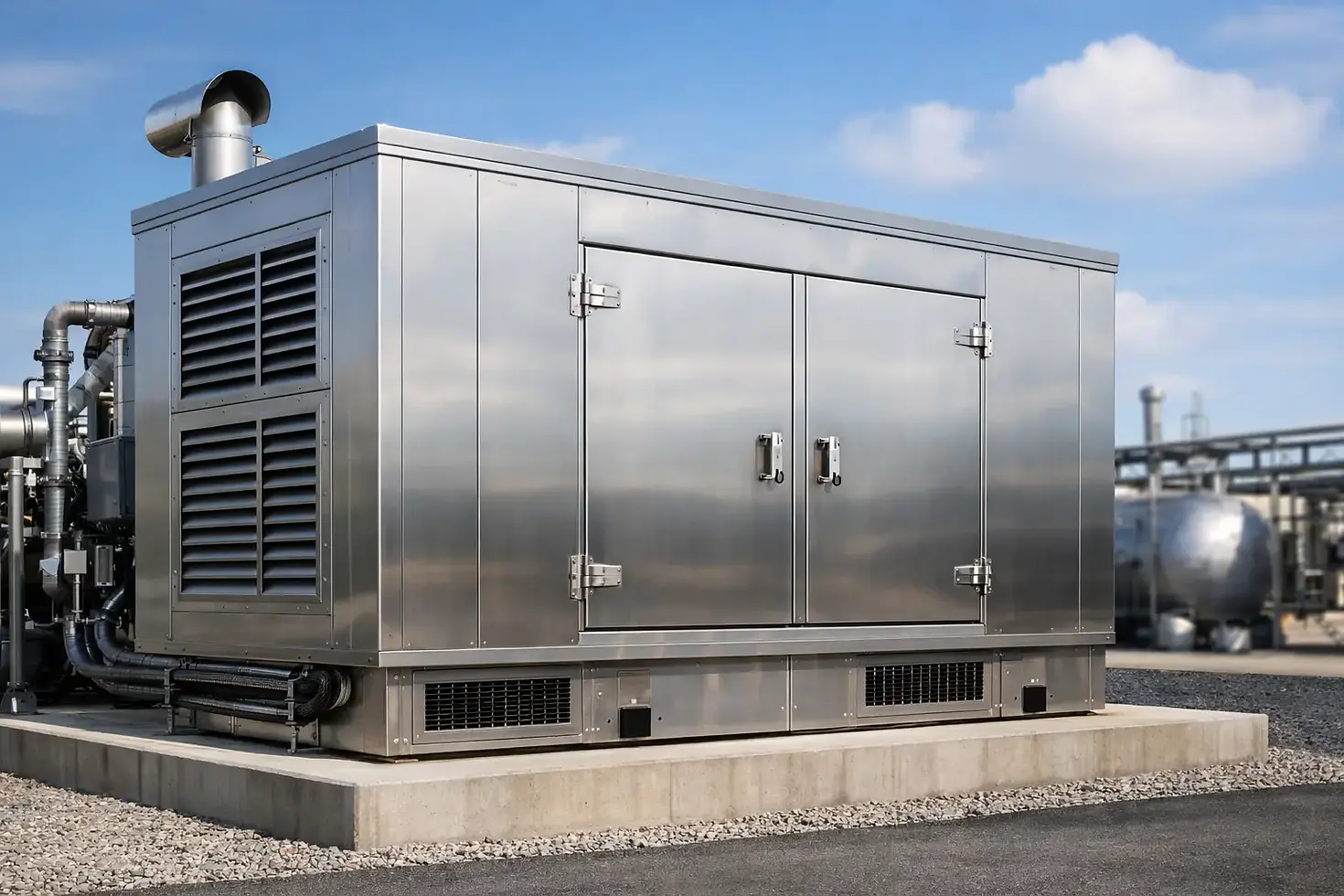
Stainless Steel Generator Enclosure Guide
Salt air destroys cheap equipment faster than most buyers expect. If your generator will sit near the coast, on an island site, at a marina, or anywhere humidity and airborne chlorides stay high, a stainless steel generator enclosure is not a cosmetic upgrade. It is a durability decision that affects service life, maintenance cost, appearance, and how often you deal with rust-related failures.
For buyers comparing package pricing, this is where the numbers need to be looked at properly. A painted mild steel canopy may cost less on day one, but corrosion starts at seams, latches, hardware, hinges, cut edges, and fastener points. Once that starts, you are paying for repainting, panel replacement, latch failures, door alignment issues, and more downtime than the original quote suggested. In coastal and Caribbean conditions, enclosure material is not a small line item. It is part of the operating strategy.
Why choose a stainless steel generator enclosure
The main reason is simple - corrosion resistance in aggressive environments. Stainless steel performs far better than standard painted steel when exposed to salt spray, humidity, heat, and frequent weather shifts. For hotels, apartment complexes, telecom sites, marine facilities, utilities support locations, and remote properties, that matters because the enclosure is the first line of defense for the generator set, controls, and access points.
A stainless steel generator enclosure also holds up better visually over time. That matters more than some buyers admit. If the unit is installed at a resort, retail property, healthcare site, or premium residential development, rust streaking and peeling panels quickly become a maintenance and appearance issue. Stainless helps preserve the condition of the package and supports longer asset life with less cosmetic degradation.
There is also a practical service benefit. Doors, hinges, locks, and mounting points tend to remain more functional over time when corrosion is controlled. Service access stays easier. Panels are less likely to seize, distort, or weaken at the edges. That reduces labor frustration for technicians and lowers the chance that basic maintenance gets delayed because the enclosure itself has become part of the problem.
Where stainless steel pays off fastest
Not every project requires stainless steel. If a generator is installed inland, under controlled conditions, and used in a less corrosive environment, aluminum or properly finished steel may be acceptable depending on budget and expected runtime. But in coastal procurement, buyers usually regret going too cheap on enclosure material, not too strong.
Stainless steel usually makes the most sense for oceanfront properties, island installations, marinas, ports, wastewater facilities, food processing areas, and any site where wind-driven salt and moisture are constant. It is also a smart choice for standby units that may sit outside for long periods between runs. A generator that looks fine at delivery but deteriorates while waiting for emergency use is not a good value.
For Bahamas buyers and other export customers, the enclosure decision also ties into shipping and replacement lead times. If replacement panels or repainting work are difficult to organize locally, a more corrosion-resistant package up front often saves more money than the initial delta in equipment cost.
What to look for in a stainless steel generator enclosure
Not all stainless packages are built the same. Buyers should ask what grade of stainless steel is used, where it is used, and whether the entire enclosure or only selected panels are stainless. Marine and coastal applications need clear answers here.
Grade matters. In many cases, 304 stainless is a solid improvement over painted steel, but 316 stainless offers better resistance in harsher salt-air environments. The right choice depends on exposure level, distance from the water, washdown requirements, and budget. A site directly on the coast or at a marine facility may justify 316. A property farther inland may find 304 sufficient.
Construction details matter just as much as the base material. Ask about frame construction, panel thickness, louver design, rain protection, hardware material, gasketing, and whether fasteners are stainless as well. A stainless enclosure with mixed low-grade hardware can still create corrosion points. Good fabrication is not just about sheet metal. It is about how the whole package is assembled.
Sound attenuation should also be reviewed early. Many buyers need weather protection and corrosion resistance, but they also need a quiet package for occupied properties. A stainless steel generator enclosure can be supplied in weather-protective or sound-attenuated configurations. The quieter package is usually larger and more expensive, but for hotels, multifamily, healthcare, and commercial sites, it is often the right call.
The enclosure has to match the generator package
A good enclosure is not separate from the generator specification. It must be matched to engine cooling requirements, alternator airflow, service clearances, fuel system layout, and control access. This is where many quote comparisons go wrong. One supplier may show a low generator price, but the enclosure, base tank, controls, and weather protection are not specified to site conditions.
For example, a 60kW standby package for a small commercial site has very different enclosure and airflow needs than a 500kW prime power system serving a remote development. Larger units produce more heat, require different acoustic treatment, and may need integrated fuel storage, external fill arrangements, or special access doors for maintenance. The enclosure should be sized around actual operation, not just made to fit the genset footprint.
If you are quoting a complete package, review the full configuration: diesel or gas fuel type, standby or prime duty, run time target, ambient temperature, noise level requirement, controller type, voltage, frequency, and delivery destination. On coastal projects, enclosure material should be treated as a core specification, not an accessory.
Cost trade-offs buyers should consider
Stainless steel costs more than standard painted steel. There is no reason to pretend otherwise. The better question is whether it lowers total cost over the equipment life.
In many coastal applications, the answer is yes. You may spend more up front, but you reduce corrosion-related maintenance, repainting cycles, hardware replacement, and premature enclosure deterioration. You also protect resale value and reduce the chance that the package looks neglected years before the engine and alternator are actually worn out.
That said, it depends on the site. If the generator is installed in a protected inland area with limited salt exposure, aluminum may be a competitive option and provide a good balance of corrosion resistance and cost. If the budget is tight and the runtime is low, a buyer may accept a less expensive enclosure knowing the maintenance trade-off. Good procurement is not about buying the most expensive option. It is about matching the package to the exposure and service expectations.
Buying for export and island installation
For island and export work, enclosure selection should be tied to logistics from the start. Once the unit lands at port, gets trucked to site, or moves by mail boat to an outer island, changes become expensive. That is why complete package quoting matters.
A serious quote should identify generator rating, enclosure material, sound level, tank configuration, controls, and delivery terms clearly. If customs duties, port fees, VAT exposure, and final delivery handling are part of the procurement process, buyers should account for them before comparing offers. A cheap quote that leaves out corrosion-resistant fabrication or site-specific delivery realities is not actually the lower-cost option.
This is where Carib Generators fits the market well. Buyers in the Bahamas and similar coastal environments often need more than a genset. They need a package built for salt air, quoted with realistic shipping terms, and configured to arrive ready for installation rather than requiring multiple suppliers to close the gaps.
Questions worth asking before you buy
Ask the supplier whether the enclosure is 304 or 316 stainless, whether the hardware is stainless, and whether the package is weather-protective or sound-attenuated. Confirm access door layout, maintenance clearance, fuel tank integration, and controller visibility. If your site is near occupied buildings, ask for the expected sound level at a stated distance.
You should also ask how the enclosure affects serviceability. A clean exterior specification is not enough if routine maintenance becomes harder because of poor access. Oil checks, filter changes, breaker access, and control inspection should all be straightforward.
Finally, ask the supplier to quote the package for your real environment, not a generic one. Coastal distance, exposure level, runtime profile, and logistics route all matter. The right stainless enclosure is not simply a better box. It is part of a generator system built to last where standard equipment fails early.
If your site deals with salt, moisture, and hard weather, buy the enclosure once and buy it right. That decision usually costs less than fixing corrosion for the next ten years.


Comments