

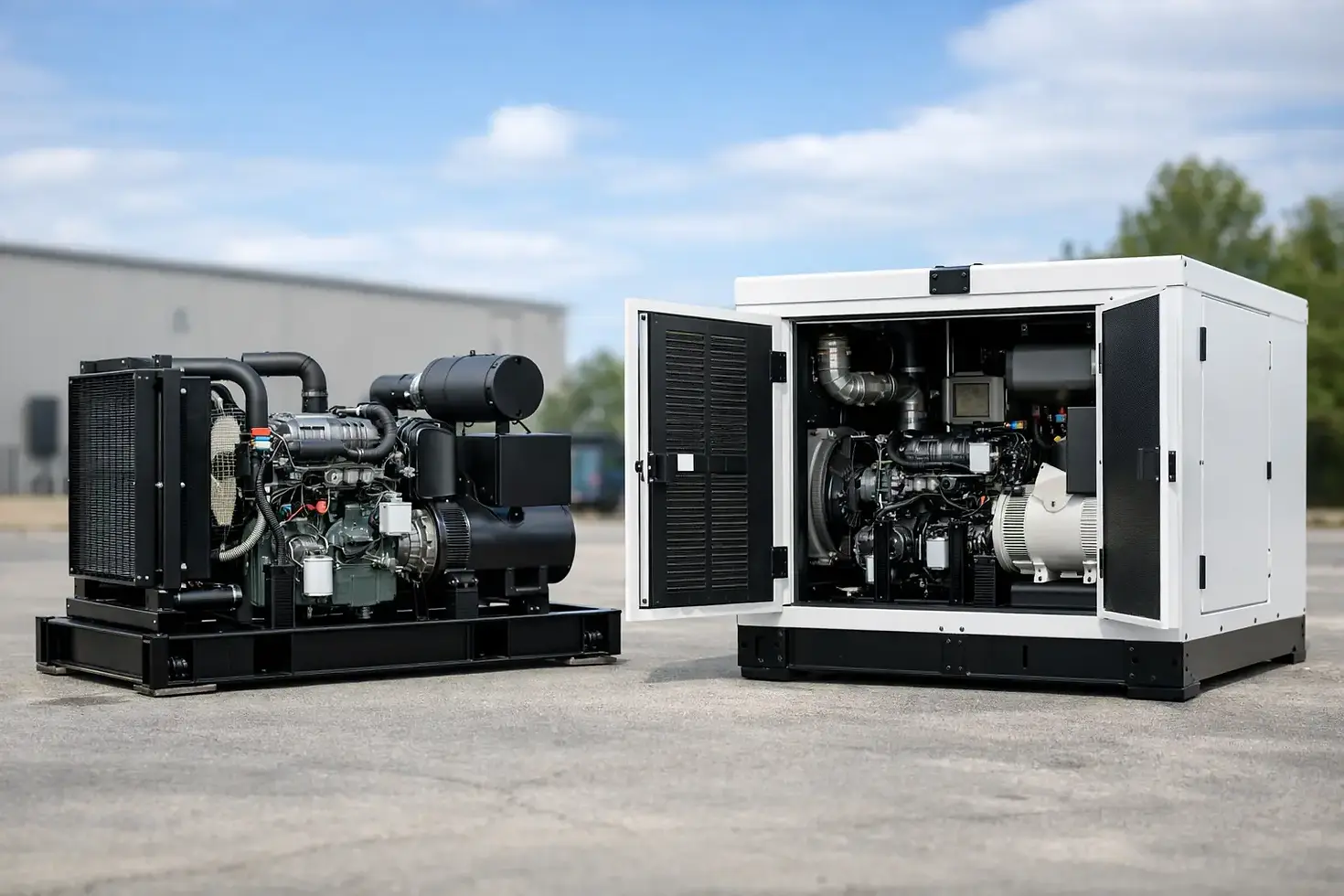
Open Skid vs Enclosed Generator Options
A cheap generator becomes expensive quickly when the package does not match the site. The open skid vs enclosed generator decision affects far more than the initial equipment price. It determines where the unit can be installed, how much site work is required, whether neighbors hear it during an outage, and how well it will hold up against salt air, rain, heat, and wind-driven moisture.
For hotels, apartment buildings, construction projects, marinas, remote homes, retail facilities, and utility-support applications, the right answer depends on the operating environment and the scope of the complete power package. An open skid may be the lowest-cost solution for a protected equipment room. A properly specified enclosed generator may reduce installation work and protect the investment from day one.
Open Skid vs Enclosed Generator: The Core Difference
An open skid generator is an engine, alternator, controls, radiator, and base frame supplied without a weatherproof outer canopy. It is intended for installation inside a generator room, plant room, mechanical space, or another structure that protects it from weather and controls access. Open skid units are common in commercial buildings where the owner already has a suitable equipment area.
An enclosed generator includes a factory-built canopy around the generating set. Depending on the specification, that enclosure can provide weather protection, sound attenuation, security, ventilation management, and corrosion resistance. Enclosed packages are normally installed outdoors on a prepared concrete pad or structural base.
The distinction matters because an enclosure is not just a metal box. It has louvers, air intake and discharge paths, access doors, exhaust provisions, lifting points, acoustic material on quieter models, and finishes designed for the installation environment. A poorly specified enclosure can create heat problems, restrict service access, or corrode early in a coastal location.
When an Open Skid Generator Makes Financial Sense
Open skid units typically carry a lower equipment cost than comparable enclosed models. They are a practical choice when the project already includes a dedicated generator room with adequate ventilation, fire protection, drainage, exhaust routing, lighting, and secure access.
For a large commercial facility, placing a 500 kW, 1,000 kW, or larger diesel generator inside a purpose-built plant room can be more efficient than purchasing a large outdoor canopy. The building itself provides weather protection, while the project team can design intake louvers, discharge ducts, silencers, and fuel systems around the equipment.
Open skid equipment also gives engineers more flexibility for customized indoor layouts. Remote radiators, vertical exhaust runs, day tanks, bulk fuel transfer systems, and switchgear lineups are easier to coordinate when the generator is part of a larger mechanical plant design.
That lower purchase price should not be mistaken for a lower installed price. If a building does not already have a compliant generator room, the cost of constructing one can exceed the price difference between an open unit and a factory enclosure. The room must handle heat rejection, engine exhaust, noise, maintenance clearance, fuel containment, and hurricane-related building requirements where applicable.
An open skid should never be treated as an outdoor unit with a tarp or a lightly built shed added afterward. Improvised covers often restrict radiator airflow, trap heat, expose electrical controls to moisture, and make routine service difficult.
Why Enclosed Generators Fit Most Outdoor Caribbean Sites
For outdoor installations in the Bahamas and other coastal markets, an enclosed generator is usually the more direct path to a deployable power system. The package arrives with the generating set protected by a purpose-built canopy, reducing the amount of field fabrication required before startup.
Weatherproof enclosures protect against rain and direct sun, but coastal buyers should look beyond the word weatherproof. Salt-laden air attacks mild steel, fasteners, hinges, louvers, weld areas, and electrical cabinets. Standard painted steel enclosures can be appropriate in some environments, but they require maintenance and may not be the best long-term choice near the water.
For exposed island properties, marine-grade stainless steel or aluminum enclosure options can materially improve service life. The correct material depends on the site, budget, required sound level, and fabrication design. Stainless steel provides strong corrosion resistance and durability. Aluminum offers excellent corrosion performance with lower weight. Both should be specified with suitable hardware, door seals, coatings where needed, and serviceable components.
An enclosure also helps control unauthorized access. This matters for generators at remote lots, construction sites, marinas, utility areas, and properties where the equipment cannot be continuously monitored. Lockable access doors and protected control panels reduce the chance of tampering during a critical outage.
Noise Is Usually the Deciding Factor
An open skid generator inside a well-designed equipment room can operate quietly outside the building, but only if the room is engineered for sound control. Without acoustic treatment, noise travels through intake openings, discharge louvers, walls, roof structures, and exhaust piping.
Outdoor enclosed generators are available in weatherproof and sound-attenuated configurations. A weatherproof canopy offers basic protection but may not meet the expectations of a hotel, apartment complex, clinic, school, or mixed-use property. A sound-attenuated enclosure uses acoustic insulation, baffled air paths, and appropriate silencers to reduce operating noise.
Buyers should request a stated sound rating, commonly measured in dBA at a defined distance. Do not compare sound figures unless the measurement distance, load condition, and test method are clear. A generator that seems acceptable at a depot can become a serious operating issue when it is installed beside guest rooms or residential units.
Heat Management Cannot Be an Afterthought
Every diesel or gas generator produces substantial heat. An enclosure must bring in enough cooling air, discharge hot radiator air without recirculation, and maintain acceptable engine-room temperatures around electrical controls. This is especially relevant in high ambient Caribbean conditions.
A factory enclosure is designed around the radiator and airflow requirements of the specific generator model. That is a major advantage over a site-built cover. However, installation still matters. The discharge end cannot be placed tight against a wall, stacked materials cannot block louvers, and the unit should not sit where prevailing winds force hot air back into the intake.
For either option, the generator should be sized using actual load data, motor starting requirements, voltage, phase, frequency, duty rating, and expected ambient conditions. Oversizing solely for future capacity can create poor loading and unnecessary fuel expense. Undersizing can cause voltage dips, overload alarms, and failed starts when the facility needs power most.
Fuel Tanks, Controls, and Transfer Equipment Change the Package
The generator itself is only one part of a working standby or prime-power system. Whether selecting open skid or enclosed equipment, the buyer should define the fuel autonomy required. A small day tank may be sufficient for short outages. A remote bulk tank or integrated base tank may be necessary where resupply is limited or outages regularly last for days.
For coastal installations, tank material and containment are as relevant as enclosure material. Stainless steel and aluminum fuel tank options help address corrosion concerns, while properly designed fuel supply and return connections support cleaner, more dependable operation. Tank capacity must account for generator consumption at expected load, delivery access, local regulations, and the practical ability to refuel during severe weather.
Controls should also be specified upfront. At minimum, most standby projects require an automatic transfer switch sized for the electrical service and generator output. The ATS detects utility failure, starts the generator, transfers the load, and returns the facility to utility power when service stabilizes. Remote monitoring, programmable controllers, load management, battery chargers, block heaters, and emergency stop arrangements should be selected based on the site's operating requirements.
A smaller enclosed unit with an integrated fuel tank and ATS can be a cleaner solution than a less expensive open skid that requires several separate vendors and substantial field integration. Conversely, a large open skid installation may be the correct choice where a contractor is already building a full generator plant with dedicated switchgear and bulk fuel storage.
Compare Installed Cost, Not Generator Price Alone
The useful comparison is not open skid price versus enclosed price. It is the delivered, installed, and supportable cost of the complete system.
For an open skid project, account for the generator room, ventilation louvers, discharge ducting, exhaust system, silencing, security, electrical works, fuel system, and corrosion protection. For an enclosed generator project, account for the canopy specification, concrete pad, crane or forklift access, cable trenching, ATS, fuel storage, clearance around service doors, and shipping dimensions.
Freight deserves early attention. A large enclosed generator can require special handling, while a separate open skid, enclosure, tank, and accessories may create more pieces to coordinate. For island delivery, buyers should confirm FOB or CIF terms, destination port requirements, customs costs, port fees, inland transport, and final site access before ordering. The lowest quoted equipment price is not a saving if the package cannot be moved from the dock to the pad.
Carib Generators can quote generator, enclosure, fuel tank, controls, and delivery requirements as one configured package, which reduces the risk of purchasing components that do not fit together in the field.
Specify the Site Before You Specify the Generator
Start with the actual location. If the unit will live inside a properly engineered mechanical room, an open skid generator can deliver strong value and easier integration into a larger plant. If it will sit outdoors near salt water, exposed to rain, public access, or noise-sensitive spaces, a corrosion-resistant enclosed package is usually the better commercial decision.
Provide the required kW, voltage, phase, frequency, standby or prime rating, expected load profile, desired fuel runtime, noise limit, enclosure material, and delivery location when requesting pricing. A clear site specification turns the open skid vs enclosed generator question into a package that can be delivered, installed, and relied on when utility power disappears.


Comments