

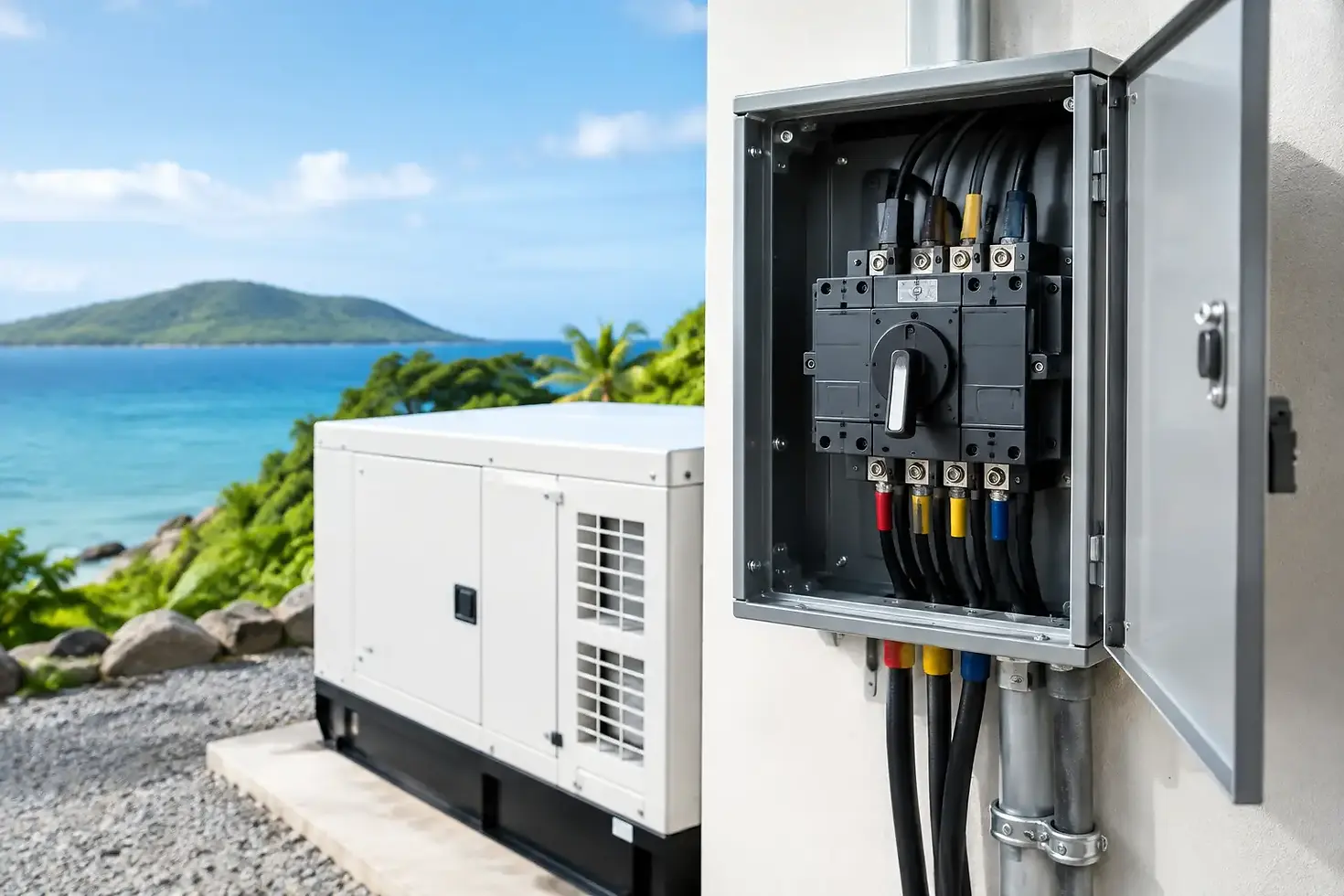
Best Automatic Transfer Switches for Island Power
A generator cannot protect a property if someone must be present to start it, disconnect utility power, and transfer the load. The best automatic transfer switches remove that exposure by monitoring the normal source, starting the generator when utility power fails, and moving critical loads to standby power in a controlled sequence. For Bahamas and coastal projects, the right ATS is not an accessory. It is a core part of the power package.
The correct switch depends on generator size, service voltage, utility configuration, load priority, and the environment around the equipment. A 200-amp switch for a small villa has little in common with a 1,200-amp, bypass-isolation switch serving a resort, marina, or multi-building commercial site. Buying on amp rating alone is one of the fastest ways to create an expensive installation problem.
What Makes the Best Automatic Transfer Switches Different
An automatic transfer switch continuously senses the normal utility source. When voltage or frequency falls outside its programmed limits, the controller sends a remote start signal to the generator. Once generator voltage and frequency stabilize, the ATS transfers the selected load. When utility power returns and remains stable through the programmed retransfer delay, the switch returns the load to normal power and allows the generator to cool down.
That sequence sounds straightforward, but the specifications behind it determine whether the system performs properly during a real outage. The best automatic transfer switches are matched to the electrical system rather than selected from a generic catalog. They must carry the required continuous current, withstand available fault current, match the number of poles required, and coordinate correctly with the generator controller and upstream breakers.
For commercial buyers, switch construction and serviceability also matter. A low-cost residential-style ATS may be acceptable for a light-duty backup application. It is not automatically the right choice for a hotel pump room, a construction operation, a cold-storage load, or a salt-air location where downtime carries a direct operating cost.
Start With the Generator and Service Rating
ATS sizing begins with the electrical service, not with a guess based on building square footage. The switch should be rated at or above the maximum expected load current and should coordinate with the generator output breaker. Common standby configurations include 100A, 200A, 400A, 600A, 800A, 1,000A, 1,200A, 1,600A, and 2,000A transfer switches, with larger gear available for major facilities.
A generator may be sized in kW, while the transfer switch is rated in amps. The connection between the two depends on voltage, phase, power factor, and the actual load profile. For example, a 150 kW three-phase generator at 480V will not call for the same ATS rating as a 150 kW generator at 208V. Lower voltage systems draw higher current for the same power output.
Do not size only to the generator nameplate if the site service and load demand require more capacity. Conversely, installing an oversized switch does not correct an undersized generator. The switch, generator breaker, feeder conductors, distribution equipment, and load calculation should be reviewed as one package.
Service entrance or downstream transfer?
A service-entrance-rated ATS can combine transfer switching with the required disconnecting means at the service location, subject to local code and utility requirements. This can reduce equipment count and simplify a new installation. A non-service-entrance-rated switch is typically installed downstream of a separate main disconnect or distribution section.
The right arrangement depends on the site. A new commercial build may favor integrated service equipment, while an existing hotel or apartment complex may require a downstream ATS to preserve the established utility service layout. Confirm the local authority requirements before equipment is released for shipment.
Choose the Right Pole Configuration
Pole count is a technical detail that should not be left to a last-minute installer decision. Three-pole switches transfer the three phase conductors and typically maintain a solid neutral connection. They are common on three-phase systems where the neutral arrangement and fault protection allow it.
Four-pole switches transfer the neutral as well as the phase conductors. They are often required where the generator is treated as a separately derived system, where neutral-to-ground bonding must be controlled, or where multiple sources and sensitive distribution arrangements require isolation. An improperly selected neutral configuration can create nuisance tripping, grounding problems, or unsafe fault-current paths.
Single-phase applications commonly use two-pole switching, but voltage and neutral requirements still need to be confirmed. For island properties with mixed loads, step-up transformers, solar equipment, or multiple generators, provide a one-line diagram during the quotation stage. It prevents a costly mismatch between the ATS, generator, and site distribution.
Open Transition, Closed Transition, and Bypass Isolation
Most standby installations use an open-transition ATS. The switch breaks from the utility source before connecting to generator power. This is commonly called break-before-make transfer. It is dependable, cost-effective, and appropriate for most homes, retail sites, offices, light industrial facilities, and standard commercial backup systems.
Closed-transition transfer briefly parallels the normal and emergency sources while moving the load. It is used when even a short interruption is unacceptable, such as certain data, process, medical, or continuous-operation loads. This equipment costs more and requires careful utility coordination, protective settings, and commissioning. It is not simply a premium feature to add to every project.
Bypass-isolation ATS equipment is built for facilities that cannot easily tolerate taking the transfer switch offline for service. A bypass section can maintain power through an alternate path while the ATS is isolated for inspection or repair. Hospitals, large resorts, critical utility support, and high-revenue operations may justify the additional cost. Smaller sites usually gain more value by investing that budget in correct generator sizing, fuel storage, and corrosion protection.
Controls That Protect the Load and the Generator
A commercial ATS controller should provide adjustable under-voltage, over-voltage, under-frequency, and over-frequency sensing. It should also include start delay, transfer delay, retransfer delay, and generator cool-down timing. These settings prevent transfers caused by brief utility disturbances and avoid moving load onto a generator before it is ready.
For larger or more complex projects, specify remote monitoring capability. Facility managers benefit from alarm indication for source availability, switch position, generator run status, and transfer events. Remote communications do not eliminate site maintenance, but they can shorten response time when a property is unattended or located on an outer island.
Load management is another practical control feature. Rather than sizing a generator for every possible load at once, a control system can prioritize life safety, refrigeration, water pumps, communications, security, and essential guest services. Lower-priority air conditioning or noncritical equipment can be added after generator capacity is confirmed. This approach can reduce generator size and fuel consumption, but it needs a disciplined load schedule and properly controlled contactors or breakers.
Coastal Construction Is Part of the Specification
Salt air, heat, humidity, wind-driven rain, and long service intervals are hard on electrical equipment. The enclosure rating and material should match the installation environment. Indoor-rated switches belong in dry electrical rooms. Outdoor-rated equipment needs a weatherproof enclosure suitable for direct exposure, with correctly installed conduit entries, drip protection, and access clearance for maintenance.
For exposed coastal sites, corrosion resistance deserves direct attention. Stainless steel or aluminum enclosures can be a better long-term choice than standard painted steel, particularly near docks, beachfront facilities, marine operations, and utility compounds. The same principle applies to mounting hardware, hinges, latches, and external fittings. A transfer switch is only as dependable as the enclosure protecting its controls and power contacts.
Location matters as much as material. Avoid areas prone to flooding, salt spray, exhaust discharge, and direct water entry. Leave working clearance around the cabinet and keep the route between generator, ATS, and distribution practical for cable installation and service access.
Specify the ATS as a Complete Package
A clear equipment request should identify the generator kW rating, voltage, phase, frequency, required ATS amp rating, pole count, transition type, enclosure requirement, and whether the ATS is service-entrance rated. Include the site location, utility details, main service rating, critical loads, and any requirement for remote monitoring or load shedding.
For export and island delivery, package planning should also cover shipping dimensions, crate protection, spare parts, and the relationship between the ATS, generator enclosure, and fuel tank. A factory-direct package can be configured before dispatch instead of forcing a contractor to source incompatible pieces after the generator arrives. Carib Generators can quote transfer switches alongside diesel or gas generator systems, marine-grade enclosure options, and integrated fuel storage based on the actual project requirement.
The best choice is the switch that fits the electrical design, operating priorities, and environment without adding unnecessary complexity. Provide the one-line diagram and load information early, then let the ATS specification protect the investment you are making in generation capacity.


Comments